
Which Is Better for Dialysis: Catheter or AV Fistula? A Complete Guide

Which Is Better for Dialysis: Catheter or AV Fistula? A Complete Guide Starting hemodialysis is a major change in a patient’s life. Along with understanding the dialysis process, one of the most important decisions is choosing the right vascular access. Vascular access is the route through which blood leaves the body, travels to the dialysis machine for cleaning, and returns to the bloodstream. Without reliable vascular access, hemodialysis cannot be performed effectively. The two options patients commonly hear about are a dialysis catheter and an AV fistula. Although both can provide access for hemodialysis, they are very different in how they are created, how quickly they can be used, and the risks associated with them. For many patients who are expected to need long-term hemodialysis, an AV fistula is generally preferred because it usually has fewer complications and better long-term durability than a central venous catheter. However, a catheter can be extremely useful when dialysis needs to begin urgently or when a fistula or graft is not suitable. For patients looking for a Kidney Specialist in Vijayawada, understanding these differences can make conversations about dialysis planning much easier. What Is Vascular Access for Hemodialysis? During hemodialysis, blood needs to move from the patient’s body to a dialysis machine. The machine passes the blood through a special filter called a dialyzer, where waste products and excess fluid are removed. The cleaned blood is then returned to the body. A vascular access provides this connection between the patient’s bloodstream and the dialysis machine. There are three major types of hemodialysis vascular access: AV fistula: A surgeon connects an artery and a nearby vein, usually in the arm, creating a stronger blood vessel that can later be used for dialysis needles. AV graft: A special tube is used to connect an artery and vein when the patient’s own blood vessels are not suitable for a fistula. Dialysis catheter: A soft tube is placed into a large vein, commonly in the neck or chest, allowing blood to be taken from and returned to the body without placing needles into an AV access. Each option has a role, but they are not interchangeable in every situation. What Is an AV Fistula? An arteriovenous fistula, commonly called an AV fistula or simply a fistula, is a surgically created connection between an artery and a nearby vein. It is usually created in the arm. The connection allows arterial blood flow to enter the vein, causing the vein to become larger and stronger over time. Once the fistula has matured sufficiently, dialysis needles can be placed into it during hemodialysis. An AV fistula uses the patient’s own blood vessels rather than an artificial tube. This is one of the major reasons it is generally preferred for long-term hemodialysis when it is medically suitable. The National Kidney Foundation describes a fistula as the preferred access because it generally has fewer problems and lasts longer than other access types. What Is a Dialysis Catheter? A dialysis catheter is a soft, flexible tube placed into a large vein. For hemodialysis, the catheter is commonly placed in a large vein in the neck, although other sites may be considered depending on the patient’s circumstances. Unlike a fistula, the catheter does not require the patient to wait for the access to mature before it can be used. This makes it particularly useful when dialysis needs to start urgently. For example, a patient who develops severe acute kidney injury and suddenly requires dialysis may not have enough time to wait for a fistula to mature. In such situations, a catheter may provide immediate access. However, because the catheter enters a large vein and has an external component, it carries higher risks of infection and other access-related complications than a well-functioning AV fistula. AV Fistula vs Dialysis Catheter: Which Is Better? For a patient who needs long-term hemodialysis and has suitable blood vessels, an AV fistula is generally preferred over a dialysis catheter. This does not mean that a catheter is a “bad” option. A catheter can be the right option in an emergency, during the period before a fistula is ready, or when an AV fistula or graft cannot be created. The difference is mainly about the intended duration, patient’s condition, vascular anatomy, and urgency of dialysis. A fistula generally offers better long-term durability and a lower risk of infection than a catheter. A catheter, on the other hand, provides rapid access and does not require maturation. Why Is an AV Fistula Preferred for Long-Term Dialysis? There are several reasons why an AV fistula is generally preferred when it is appropriate for the patient. Lower Infection Risk One of the major advantages of a fistula is the lower risk of bloodstream infection compared with a dialysis catheter. A catheter creates a direct pathway through the skin into a large vein. Because part of the catheter remains outside the body, strict infection-control practices are essential. A mature fistula is completely under the skin between dialysis sessions. This does not mean that a fistula can never become infected, but its infection risk is generally lower than that of a central venous catheter. Better Long-Term Durability An appropriately functioning AV fistula can provide vascular access for a long period. Because it is created using the patient’s own blood vessels, it does not depend on a synthetic tube or an external catheter. However, fistulas can develop problems such as narrowing, clotting, aneurysmal changes, or failure to mature. Regular monitoring helps identify these issues early. Good Blood Flow A mature fistula is designed to provide the blood flow needed for hemodialysis. During dialysis, two needles are typically placed into the fistula. One needle allows blood to travel toward the dialysis machine, while the other returns the cleaned blood to the patient. Good blood flow is important for delivering an effective dialysis treatment. Why Is a Dialysis Catheter Used? Although fistulas are generally preferred for long-term access, dialysis catheters remain very important. The biggest advantage is immediate usability. A
How Nephrologists Diagnose and Treat Chronic Kidney Disease

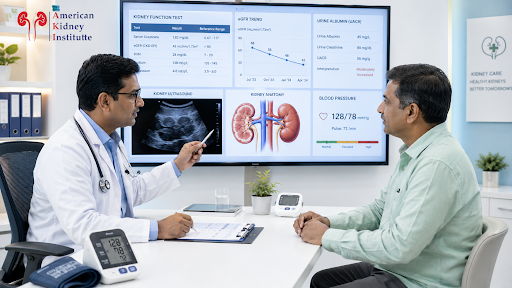
How Nephrologists Diagnose and Treat Chronic Kidney Disease Chronic kidney disease, commonly called CKD, is a long-term condition in which the kidneys become damaged or their ability to filter blood decreases over time. The condition can affect people of different ages and may develop because of diabetes, high blood pressure, inherited kidney disorders, autoimmune diseases, repeated kidney injury, and other medical conditions. One of the biggest challenges with CKD is that it can develop quietly. Many people do not experience clear symptoms during the early stages. Blood and urine tests may identify kidney damage before a person feels unwell. This is where a nephrologist plays an important role. A nephrologist is a doctor who specializes in kidney diseases. Nephrologists do more than treat advanced kidney failure. They investigate why kidney function is changing, assess the severity of kidney disease, manage complications, and create treatment plans designed to protect remaining kidney function. For people searching for the Best Nephrologist in Vijayawada, understanding how CKD is diagnosed and treated can help them recognize the importance of timely kidney care. What Is Chronic Kidney Disease? Chronic kidney disease means there is an abnormality in kidney structure or function that persists for at least three months. Healthy kidneys continuously filter the blood. They remove waste products and excess fluid through urine while helping regulate electrolytes, acid-base balance, blood pressure, and other important body functions. When kidney function becomes reduced, waste products and excess substances may gradually accumulate in the body. CKD can also lead to complications involving blood pressure, anemia, bones, minerals, heart health, and nutrition. The condition does not always progress quickly. Some people remain stable for many years, while others experience a faster decline in kidney function. This difference makes regular monitoring important. Why Can Chronic Kidney Disease Go Unnoticed? Early CKD often does not produce obvious symptoms. A person may have an abnormal kidney test while continuing to work, eat, exercise, and carry out normal daily activities. Symptoms may become more noticeable as kidney function declines. These can include swelling, tiredness, nausea, poor appetite, changes in urination, itching, muscle cramps, or shortness of breath. However, symptoms alone cannot determine whether someone has CKD. Testing is important because blood and urine tests can identify kidney damage or reduced filtration before serious symptoms develop. Who Is at Higher Risk of CKD? Certain health conditions increase the risk of developing kidney disease. People who may need regular kidney evaluation include those with: Diabetes, particularly when blood glucose has been difficult to control over time. High blood pressure, especially when it remains uncontrolled or requires multiple medicines. Heart disease or other cardiovascular conditions associated with increased kidney risk. A family history of kidney failure or certain inherited kidney diseases. Previous episodes of acute kidney injury or repeated kidney-related problems. Conditions such as autoimmune diseases that can affect the kidney’s filtering structures. NIDDK identifies diabetes, hypertension, cardiovascular disease, and family history of kidney failure among important CKD risk factors. When Should You See a Nephrologist? You may need nephrology evaluation when kidney tests are repeatedly abnormal or when kidney function is changing. Common reasons include: Persistently elevated creatinine or reduced eGFR on blood tests. Protein or albumin repeatedly detected in urine. A rapid or unexplained decline in kidney function. Blood in the urine with other kidney abnormalities. High blood pressure that remains difficult to control. Unexplained swelling or fluid retention. Repeated kidney stones, infections, or other kidney-related problems. Abnormal potassium, calcium, phosphorus, or bicarbonate levels associated with reduced kidney function. Advanced CKD where dialysis or kidney transplantation may eventually need to be considered. Early specialist evaluation does not mean dialysis is immediately required. In many cases, the purpose is to understand the problem early and protect kidney function. How Do Nephrologists Diagnose CKD? Diagnosing CKD involves several pieces of information. A nephrologist may review your medical history, symptoms, previous laboratory reports, medications, blood pressure readings, blood tests, urine tests, and imaging results. The two major markers used to identify and monitor CKD are eGFR and urine albumin. The doctor also needs to determine whether the abnormality is truly chronic. An abnormal test caused by temporary dehydration or an acute illness should not automatically be labeled as chronic kidney disease. Understanding Creatinine Creatinine is a waste product produced through normal muscle metabolism. Healthy kidneys remove creatinine from the blood. When kidney filtration decreases, blood creatinine may increase. However, creatinine is not a perfect measure of kidney function by itself. Muscle mass, age, diet, certain medicines, and other factors can affect creatinine levels. For this reason, nephrologists usually interpret creatinine alongside eGFR and other findings. A single elevated creatinine result does not automatically mean that someone has permanent CKD. What Is eGFR? The estimated glomerular filtration rate, or eGFR, estimates how efficiently the kidneys filter blood. It is calculated using blood-test information and an established estimation equation. A persistently reduced eGFR can indicate chronic kidney disease. NIDDK notes that an eGFR below 60 may indicate kidney disease, while an eGFR of 15 or lower is generally considered the kidney failure range. However, doctors do not make treatment decisions based on eGFR alone. The patient’s symptoms, urine albumin, underlying cause, rate of change, other laboratory findings, age, and overall health also matter. Why Is Urine Testing Important? Blood tests tell doctors about kidney filtration, but urine tests provide different information. One important test is the urine albumin-to-creatinine ratio, or UACR. Albumin is a protein normally found in the blood. Healthy kidneys generally prevent significant amounts of albumin from passing into urine. When the kidney’s filtering barrier is damaged, albumin can leak into urine. Persistent albuminuria can therefore be an important sign of kidney damage. A UACR above 30 mg/g may indicate increased urine albumin, although results need to be interpreted in the clinical context and may be repeated for confirmation. What Other Urine Tests May Be Done? A nephrologist may order a complete urinalysis depending on the patient’s condition. The test can provide information about: Protein: Persistent protein

Translate »