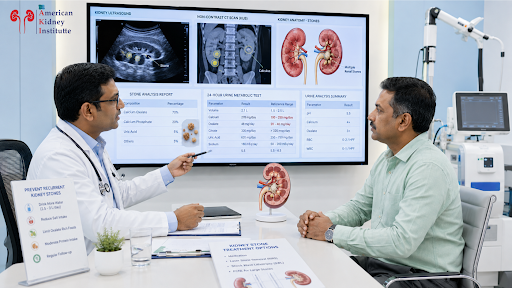
Kidney Stone Treatment in Vijayawada for Recurrent Kidney Stones
Kidney stones can be extremely painful, but for people who experience them repeatedly, the problem can be much more than a single episode of pain. When stones keep coming back, it may indicate that certain factors in the urine, diet, metabolism, genetics, medications, or lifestyle are making stone formation more likely.
A person who has had one kidney stone already has a higher chance of developing another. This makes prevention an important part of treatment rather than simply removing each stone whenever it appears.
Recurrent kidney stones can also vary in size, location, and composition. Some small stones may pass naturally, while larger stones or stones causing blockage, infection, persistent pain, or kidney problems may require a procedure.
Understanding why stones are forming is therefore an important step toward reducing future episodes.
This is where a detailed evaluation becomes valuable. At American Kidney Institute, kidney-related concerns can be evaluated with attention to the patient’s medical history, kidney health, laboratory findings, and risk factors.
For people searching for Kidney Stone Treatment in Vijayawada, it is important to understand that successful treatment is not only about removing the current stone. It is also about reducing the chances of another stone forming.
What Are Kidney Stones?
Kidney stones are hard, solid deposits that develop when certain minerals and substances become concentrated in urine and form crystals.
These crystals can gradually grow into stones.
Some stones remain inside the kidney without causing symptoms. Others move into the ureter, the tube that carries urine from the kidney to the bladder.
When a stone blocks urine flow, it can cause severe pain.
Common symptoms may include:
- Sharp pain in the side, back, lower abdomen, or groin that may come in waves as the stone moves through the urinary tract.
- Blood in the urine, which may make urine appear pink, red, brown, or darker than usual.
- Nausea or vomiting, particularly when the pain is severe.
- Pain or burning during urination, especially when the stone is close to the bladder.
- A frequent or urgent need to urinate when the stone is located lower in the urinary tract.
- Fever or chills, which can be particularly concerning because an obstructed urinary tract with infection may require urgent treatment.
Not every kidney stone causes symptoms.
Some are discovered incidentally during imaging performed for another reason.
Why Do Kidney Stones Keep Coming Back?
Recurrent stones can happen for several reasons.
The urine may contain too much of a stone-forming substance, too little of a substance that normally prevents crystals from growing, or not enough water to keep minerals diluted.
Diet can also influence stone risk.
High sodium intake, certain patterns of animal protein consumption, inadequate fluid intake, and other dietary factors may increase the likelihood of stones in susceptible people.
Medical conditions can also contribute.
Some people have metabolic disorders, bowel conditions, genetic diseases, or urinary abnormalities that increase their risk.
This is why recurrent stones should not simply be treated as isolated episodes.
A detailed evaluation can help identify the factors that are contributing to recurrence.
When Is a Kidney Stone Considered Recurrent?
There is no need to wait for numerous stone episodes before discussing prevention.
A person who has experienced multiple stone events, has multiple stones, or has a high-risk medical condition may benefit from a more detailed metabolic evaluation.
The American Urological Association recommends additional metabolic testing for recurrent stone formers and selected high-risk patients.
This can help determine whether the urine contains unusually high levels of calcium, oxalate, uric acid, or other substances associated with stone formation.
The results can then be used to create a more individualized prevention plan.
Why Recurrent Kidney Stones Need More Than Pain Treatment
Pain relief is important during an acute kidney stone episode.
However, treating pain does not address the reason the stone formed.
If the underlying risk factors remain unchanged, another stone may develop later.
This can create a repeated cycle:
Stone formation → pain → treatment → temporary relief → another stone → another treatment.
A better long-term approach is:
Stone treatment → stone analysis → metabolic evaluation → targeted prevention → regular follow-up.
The goal is to reduce future stone formation while protecting kidney and urinary tract health.
How Are Recurrent Kidney Stones Diagnosed?
Diagnosis usually begins with a detailed medical history.
The doctor may ask about previous stone episodes, the size and location of earlier stones, previous procedures, family history, dietary habits, fluid intake, medications, and other medical conditions.
Blood and urine tests can provide additional information.
Imaging is often used to identify the location and size of existing stones and to look for obstruction or other urinary abnormalities.
The combination of these findings helps determine the most appropriate treatment.
Imaging Tests for Kidney Stones
Imaging helps doctors understand where the stone is located and how large it is.
Depending on the situation, imaging may include ultrasound, X-ray-based studies, or CT imaging.
The choice depends on symptoms, clinical circumstances, previous imaging, age, pregnancy status, and other factors.
Imaging can help answer important questions:
- Where is the stone located?
- How large is the stone?
- Is urine flow blocked?
- Are there multiple stones?
- Are stones present in both kidneys?
- Is there swelling of the kidney caused by obstruction?
For recurrent stone patients, imaging can also help doctors monitor existing stones over time.
Why Stone Analysis Is Important
If a stone is passed naturally or removed during a procedure, it may be possible to analyze its composition.
This is extremely useful for recurrent stone patients.
Different stones have different causes and prevention strategies.
Common stone types include:
- Calcium oxalate stones
- Calcium phosphate stones
- Uric acid stones
- Struvite or infection-related stones
- Cystine stones
The American Urological Association recommends obtaining stone analysis at least once when a stone is available.
Knowing the stone type can help doctors make more specific dietary and medical recommendations.
What Is a 24-Hour Urine Test?
A 24-hour urine collection can provide detailed information about the substances in the urine that influence stone formation.
This test may measure:
- Urine volume
- Calcium
- Oxalate
- Uric acid
- Citrate
- Sodium
- Potassium
- Creatinine
- Urine pH
The American Urological Association recommends metabolic testing for recurrent stone formers and describes one or two 24-hour urine collections as part of the evaluation.
This information can help identify a specific risk pattern.
For example, one patient may have excessive urinary calcium while another may have low urine volume.
Their prevention plans may therefore be completely different.
Why Urine Volume Matters
Low urine volume is one of the important risk factors for kidney stone formation.
When you produce less urine, minerals and other stone-forming substances become more concentrated.
This makes it easier for crystals to form and grow.
Increasing fluid intake is therefore one of the most important prevention strategies for many stone formers.
NIDDK states that drinking enough liquid, mainly water, is the most important dietary measure for preventing many types of kidney stones.
However, people with kidney failure, heart failure, or certain other medical conditions may have fluid restrictions.
The right amount of fluid should therefore be individualized.
How Much Water Should You Drink?
Many people with recurrent stones are advised to increase fluid intake to maintain adequate urine production.
The exact amount varies based on climate, physical activity, sweating, diet, kidney function, and the type of stone.
People living in hot climates may lose significant amounts of water through sweating.
This is especially relevant in warm regions, where dehydration can occur more easily.
Rather than focusing only on a fixed number of glasses, your healthcare professional may use urine volume and other factors to guide your fluid target.
If you have kidney failure or another condition requiring fluid restriction, do not increase fluid intake without medical advice.
The Role of Sodium in Kidney Stone Prevention
Salt and sodium can influence kidney stone risk.
A high-sodium diet can increase the amount of calcium excreted in urine in some people.
This can contribute to calcium-based stone formation.
Common sources of excess sodium include:
- Packaged and processed foods that may contain significant amounts of added salt.
- Restaurant and fast foods that can contain more sodium than expected.
- Pickles, salty snacks, sauces, instant foods, and heavily salted meals.
- Processed meats and certain packaged foods that may contain hidden sodium.
Reducing unnecessary sodium can therefore be an important part of stone prevention.
Does Calcium Cause Kidney Stones?
This is one of the most common misconceptions about kidney stones.
Many calcium stones do not mean that a person should completely eliminate calcium from their diet.
In fact, dietary calcium can be important for bone health and may help reduce oxalate absorption in the intestine when consumed appropriately with meals.
The correct amount depends on the individual.
People with calcium stones should discuss calcium intake with their doctor or dietitian instead of eliminating dairy or other calcium-containing foods without guidance.
What Is Oxalate?
Oxalate is a naturally occurring substance found in many foods.
When oxalate levels in urine are high, it can combine with calcium and contribute to calcium oxalate stone formation.
Foods relatively high in oxalate include spinach, certain nuts, peanuts, rhubarb, and wheat bran.
However, avoiding every food that contains oxalate is usually unnecessary.
The appropriate approach depends on your stone type and 24-hour urine results.
A dietitian can help create a balanced diet rather than an unnecessarily restrictive one.
Can Animal Protein Increase Stone Risk?
Animal protein can influence urine chemistry in ways that may increase stone risk for some patients.
Certain animal-protein-heavy diets can affect urinary calcium, uric acid, and citrate.
This does not mean that everyone with kidney stones must stop eating animal protein.
Instead, the amount and type of protein should be considered in the context of the person’s overall diet and metabolic testing.
For some recurrent stone patients, moderating excessive animal protein may be beneficial.
What Are Uric Acid Stones?
Uric acid stones form when uric acid becomes concentrated in the urine, particularly when urine is persistently acidic.
People with gout, certain metabolic conditions, obesity, diabetes, or diets high in certain animal proteins may have increased risk.
Unlike calcium stones, uric acid stones may sometimes be treated or prevented by changing urine chemistry.
Increasing urine pH through appropriate medical treatment can help prevent uric acid crystallization in selected patients.
Treatment should be based on medical evaluation rather than self-treatment.
What Are Struvite Stones?
Struvite stones are associated with certain urinary tract infections caused by bacteria that can change urine chemistry.
These stones can grow rapidly and sometimes become large.
Because infection can contribute to their formation, treatment requires addressing the infection as well as the stone itself.
Recurrent urinary infections together with recurrent stones require careful evaluation.
What Are Cystine Stones?
Cystine stones are uncommon and are associated with a genetic condition called cystinuria.
People with cystine stones can develop stones repeatedly, sometimes from a young age.
Prevention may require very high fluid intake, dietary strategies, urine alkalinization, and specific medicines in selected patients.
Because cystine stones have a genetic basis, recurrent cases may require specialized evaluation.
When Can a Kidney Stone Pass Naturally?
Some smaller stones can pass through the urinary tract without a procedure.
The likelihood depends on factors such as stone size, location, anatomy, and whether there is obstruction.
A doctor may recommend observation when the stone is likely to pass and there are no dangerous complications.
Pain management and follow-up imaging may be part of conservative treatment.
However, patients should not assume that every painful stone will pass safely.
When Does a Kidney Stone Need a Procedure?
A procedure may be considered when the stone is unlikely to pass, causes persistent symptoms, produces obstruction, contributes to infection, causes kidney function problems, or continues to create significant complications.
The treatment chosen depends on stone size, location, composition, anatomy, symptoms, and overall health.
Common procedures include:
- Extracorporeal shock wave lithotripsy (ESWL), which uses shock waves to break a stone into smaller pieces that can then pass through the urinary tract.
- Ureteroscopy, in which a small scope is passed through the urinary tract to locate and remove or fragment the stone, often using laser energy.
- Percutaneous nephrolithotomy (PCNL), which is generally used for larger or complex kidney stones and removes stones through a small access tract into the kidney.
The most appropriate procedure should be determined by a qualified urology team.
What Is Laser Treatment for Kidney Stones?
Laser stone treatment is commonly performed during ureteroscopy.
A thin scope is passed through the urinary tract to reach the stone.
Laser energy can break the stone into smaller fragments or dust-like particles, which can then be removed or allowed to pass depending on the situation.
Ureteroscopy is one of the established minimally invasive approaches used for appropriate ureteral and kidney stones.
The choice of treatment depends on the stone’s size, location, anatomy, and other factors.
What Is ESWL?
Extracorporeal shock wave lithotripsy uses focused shock waves from outside the body to break a stone into smaller pieces.
The fragments can then pass through the urinary tract.
ESWL may be suitable for selected stones based on their size, location, density, and patient factors.
It is not the ideal treatment for every stone.
A doctor will evaluate imaging and other factors before recommending it.
What Is PCNL?
Percutaneous nephrolithotomy is a procedure generally used for larger or complex kidney stones.
A small tract is created through the skin into the kidney, allowing specialized instruments to reach and remove the stone.
PCNL can be particularly useful for high stone burdens.
Because it is more invasive than some other stone treatments, the risks and benefits must be considered carefully.
Recurrent Stones and Kidney Function
Repeated stones do not automatically mean that kidney failure will occur.
However, recurrent obstruction, infections, or other complications can potentially affect kidney health.
This makes follow-up important.
Patients with recurrent stones should not focus only on pain episodes.
They should also consider whether stones are repeatedly blocking urine flow or whether there are underlying conditions affecting kidney function.
This is especially important for people who have only one functioning kidney.
Recurrent Kidney Stones and Urinary Infection
A kidney stone and urinary infection can sometimes occur together.
Symptoms such as fever, chills, burning urination, cloudy urine, or feeling severely unwell may indicate infection.
An infected, obstructed urinary system can be a medical emergency.
Patients with severe stone pain and fever should seek urgent medical attention rather than waiting for the stone to pass.
Treatment may require urgent drainage of the urinary system along with antibiotics, followed by definitive stone treatment when appropriate.
When Should You Seek Urgent Care?
Not every kidney stone requires an emergency visit, but certain symptoms should never be ignored.
Seek urgent medical care if you develop:
- Fever or chills along with suspected kidney stone symptoms, particularly if urine flow may be blocked.
- Severe pain that cannot be controlled with prescribed or recommended treatment.
- Persistent vomiting that prevents you from drinking enough fluid.
- Very little or no urine output.
- Significant weakness, confusion, or feeling seriously unwell.
- Known obstruction in a person with a solitary functioning kidney.
These situations can indicate complications requiring prompt treatment.
How Can Recurrent Kidney Stones Be Prevented?
Prevention begins with identifying why the stones are forming.
General strategies may include adequate fluid intake, appropriate dietary changes, maintaining a healthy weight, moderating sodium, and following individualized medical advice.
However, prevention should become more specific when stones are recurrent.
For example, a person with high urinary calcium may need a different approach from someone with low urinary citrate.
This is why metabolic evaluation is valuable for recurrent stone formers.
Medicines for Recurrent Kidney Stones
Some patients may benefit from medicines designed to reduce future stone formation.
The medicine depends on the stone type and metabolic abnormality.
Examples may include:
- Thiazide-type medicines for selected patients with high urinary calcium.
- Potassium citrate for selected patients with low urinary citrate or certain types of stones.
- Medicines that reduce uric acid production for selected patients with recurrent uric acid or calcium stones associated with high urinary uric acid.
Medication should not be started simply because someone else with kidney stones is taking it.
The correct treatment depends on laboratory results and medical history.
NIDDK notes that healthcare professionals may prescribe medicines to prevent future kidney stones based on the type of stone and individual risk factors.
Why Follow-Up Is Important After Stone Removal
Removing a stone does not necessarily mean the risk has disappeared.
A person can form another stone months or years later.
Follow-up allows doctors to assess whether preventive measures are working.
Depending on the patient’s risk, follow-up may include repeat urine testing, blood tests, imaging, and review of dietary and medication changes.
For recurrent stone formers, long-term prevention should be considered part of treatment.
What Should You Bring to a Kidney Stone Consultation?
Before your appointment, collect previous reports if available.
Useful information includes:
- Previous ultrasound, CT, X-ray, or other imaging reports showing stone size and location.
- Laboratory reports including blood tests, urine tests, and previous 24-hour urine studies.
- Details of previous stone-removal procedures or hospital admissions.
- Any stone fragments that were collected and analyzed.
- A list of current medicines, supplements, and herbal products.
- Information about your usual water intake, diet, and previous stone episodes.
This information can help the doctor understand the pattern of recurrence.
How Does the American Kidney Institute Support Kidney Stone Care?
At American Kidney Institute, kidney-related evaluation can focus on understanding the patient’s overall kidney health and the factors that may contribute to recurrent stone problems.
For a person with repeated stones, it is important to consider more than the current episode.
The medical team may need to understand kidney function, previous stone history, laboratory findings, medications, and other health conditions.
For patients seeking Kidney Stone Treatment in Vijayawada, an individualized approach can help address both the current stone and long-term prevention.
Choosing Kidney Stone Care in Vijayawada
Choosing appropriate kidney stone care involves considering both diagnosis and treatment.
Patients should look for access to appropriate imaging, laboratory evaluation, specialist consultation, and follow-up.
It is also important to understand whether the care team can help with recurrent stones rather than treating each episode as an isolated problem.
For someone searching for Kidney Stone Treatment in Vijayawada, the availability of evaluation for recurrent stone risk can be an important consideration.
Why Recurrent Kidney Stones Should Not Be Ignored
Repeated stones can affect quality of life.
The pain may interfere with work, sleep, travel, and everyday activities.
Repeated procedures can also create stress and additional healthcare needs.
More importantly, recurrent stones may sometimes indicate an underlying metabolic or genetic problem.
The good news is that many risk factors can be identified and managed.
The objective is not simply to wait for the next stone.
The objective is to reduce the likelihood that another stone will form.
A Practical Prevention Plan for Recurrent Stone Patients
A prevention plan should be based on the patient’s stone type and metabolic evaluation.
It may involve:
- Maintaining adequate fluid intake throughout the day rather than drinking a large amount only after becoming thirsty.
- Reducing excessive salt intake, especially from packaged, processed, restaurant, and heavily salted foods.
- Following an appropriate calcium intake rather than unnecessarily eliminating calcium-rich foods.
- Adjusting oxalate intake when calcium oxalate stones and high urinary oxalate are identified.
- Moderating excessive animal protein when recommended based on the patient’s stone type and urine results.
- Taking prescribed preventive medicines consistently when they are indicated.
- Repeating recommended urine or blood tests to determine whether prevention strategies are working.
- Attending follow-up appointments even when you are currently pain-free.
Can Diet Alone Prevent Recurrent Kidney Stones?
Diet can play a major role, but diet alone may not be enough for every recurrent stone patient.
Some people have inherited or metabolic conditions that require medication in addition to lifestyle changes.
For example, cystinuria and certain forms of hypercalciuria may require specialized treatment.
The best approach combines the patient’s stone composition, metabolic testing, dietary pattern, medical history, and risk factors.
This allows prevention to be personalized rather than based on generic advice.
Common Mistakes Made by Recurrent Kidney Stone Patients
Some habits can make prevention more difficult.
Common mistakes include:
- Drinking very little water during the day and trying to compensate by drinking a large amount at night.
- Stopping preventive medicines once the pain disappears without discussing the change with the doctor.
- Completely eliminating calcium from the diet because the previous stone contained calcium.
- Following extreme internet diets without knowing the type of stone or urine abnormality involved.
- Ignoring mild urinary symptoms because previous stones passed without complications.
- Skipping follow-up appointments because there is no current pain.
Prevention works best when it is consistent.
What Is the Role of a Dietitian?
A dietitian experienced in kidney stone prevention can help translate medical recommendations into practical meals.
This can be particularly useful for patients who need to modify sodium, oxalate, animal protein, calcium, or fluid intake.
The diet should still provide adequate nutrition.
A restrictive diet that causes nutritional deficiencies is not a good long-term prevention strategy.
Dietary recommendations should therefore be based on the patient’s health, stone type, laboratory findings, and daily lifestyle.
Kidney Stones and Family History
Family history can increase the likelihood of developing kidney stones.
If several family members have recurrent stones, doctors may consider whether there is an inherited tendency.
Certain uncommon conditions, including cystinuria and primary hyperoxaluria, can cause recurrent stones.
Early recognition can be particularly valuable because these conditions may require specialized prevention strategies.
Recurrent Stones in People With Other Health Conditions
People with diabetes, obesity, gout, bowel disease, or a history of gastrointestinal surgery may have specific factors that increase stone risk.
Certain medications can also influence urine chemistry.
This is why a complete medical history is important.
A prevention plan should consider the whole patient rather than focusing only on the stone.
When Should You See a Specialist for Recurrent Stones?
You should consider specialist evaluation if:
- You have developed kidney stones more than once.
- You have multiple stones detected on imaging.
- You have a strong family history of kidney stones.
- Your stones are large, recurrent, or difficult to remove.
- You have repeated urinary infections associated with stones.
- You have abnormal kidney-function tests.
- You have a solitary functioning kidney.
- You are young and repeatedly developing stones.
- Your stones continue forming despite basic lifestyle changes.
For patients considering Kidney Stone Treatment in Vijayawada, specialist evaluation can help identify whether there is an underlying reason for repeated stone formation.
Final Takeaway
Recurrent kidney stones should not be treated as a series of unrelated painful episodes.
When stones repeatedly return, the most important question is often not just “How do we remove this stone?” but also “Why does this patient keep forming stones?”
Diagnosis may involve imaging, blood tests, urine analysis, stone composition testing, and 24-hour urine evaluation.
Treatment depends on the stone’s size, location, composition, symptoms, obstruction, infection, and the patient’s overall health.
Small stones may sometimes pass naturally, while larger or complicated stones may require procedures such as ESWL, ureteroscopy, or PCNL.
Long-term prevention may include adequate hydration, appropriate dietary changes, sodium reduction, individualized calcium and oxalate management, medication, and regular follow-up.
For patients looking for Kidney Stone Treatment in Vijayawada, choosing care that addresses both stone removal and recurrence prevention can provide a more complete approach.
At American Kidney Institute, patients can discuss recurrent kidney stones, kidney health, metabolic risk factors, and long-term prevention with an appropriate medical team.
The goal is not simply to treat the pain when a stone appears.
The goal is to understand the reason behind recurrent stone formation and take appropriate steps to reduce the chance of future episodes.
Frequently Asked Questions
1. Why do kidney stones keep coming back?
Kidney stones can recur because of low fluid intake, high urinary calcium or oxalate, low citrate, high uric acid, dietary factors, genetics, or certain medical conditions.
People who have already formed a stone are more likely to develop another.
Recurrent stone formers may benefit from stone analysis and metabolic testing to identify specific risks.
2. What is the best treatment for recurrent kidney stones?
There is no single treatment that is best for every recurrent stone patient.
Treatment depends on stone size, location, composition, symptoms, obstruction, and the patient’s overall health.
Long-term prevention may involve dietary changes, medicines, and treatment of the current stone when necessary.
3. How much water should I drink to prevent kidney stones?
Adequate fluid intake is one of the most important ways to reduce the risk of many kidney stones.
The exact amount should be individualized according to kidney function, climate, activity, and medical conditions.
People with kidney failure or fluid restrictions should ask their healthcare professional before increasing fluids.
4. Does eating calcium cause kidney stones?
Not necessarily, and completely eliminating dietary calcium is usually not appropriate.
For some calcium stone patients, appropriate calcium intake with meals may actually help reduce oxalate absorption.
Discuss your individual calcium requirement with your doctor or renal dietitian rather than restricting calcium on your own.
5. Can kidney stones damage the kidneys?
Many kidney stones do not cause permanent kidney damage when appropriately managed.
However, prolonged obstruction, repeated infections, or complicated stones can create risks for kidney health.
Prompt evaluation is especially important when there is severe pain, fever, reduced urine output, or known obstruction.
6. What is a 24-hour urine test for kidney stones?
A 24-hour urine test measures substances that influence stone formation, including urine volume, calcium, oxalate, uric acid, citrate, sodium, potassium, and pH.
It is particularly useful in recurrent or high-risk stone formers.
The results can help doctors create a more targeted prevention plan.
7. Can kidney stones be removed without surgery?
Some small stones can pass naturally without a procedure when there is no dangerous obstruction or infection.
Other stones may require ESWL, ureteroscopy, or PCNL depending on their size and location.
A specialist can determine whether observation or active stone removal is appropriate.
8. When should I seek urgent care for a kidney stone?
Severe pain with fever or chills, persistent vomiting, very little urine, or significant illness can indicate a complication requiring urgent evaluation.
An infected and obstructed urinary system can be particularly serious.
Patients with a solitary functioning kidney should also seek prompt medical attention for suspected obstruction.
9. Can diet prevent recurrent kidney stones?
Diet can significantly influence stone risk, but the appropriate changes depend on the stone type and urine chemistry.
Common strategies include adequate fluid intake and reducing excessive sodium, with selected patients needing changes to oxalate, animal protein, or other dietary factors.
A personalized plan is usually better than following a generic kidney-stone diet.
10. When should I seek Kidney Stone Treatment in Vijayawada?
You should seek medical evaluation when you have severe or recurring stone pain, repeated stones, blood in urine, urinary symptoms, or abnormal imaging findings.
Recurrent stones may require metabolic testing to understand why they keep forming.
Early evaluation can help treat the current stone and create a plan to reduce future recurrence.